
The commits that turned a Git forge into an SRE school
A developer can read a repository but can’t push to it. The last deploy was eighteen minutes ago. Do you restart the push service, or first check which part of the request path is broken?
That’s a decision you can try on Forkalope’s homepage now. A few commits earlier, the same homepage looked like a code repository, complete with a file list, branch controls, and a README. Following the diffs between those versions explains a bigger change than the layout: the forge became the system people would learn to operate.
The history is short enough to inspect. The changes below run from September 13 through September 18, 2026, in the website repository. They show what the site started asking visitors to do. They don’t establish that the school or its proposed operator network is already running.
A homepage dressed as a repository
The September 13 commit 7540f37, “new look again,” presented Forkalope as an open-source Git forge. Its headline promised “The familiar code forge, without one home.” Repositories, issues, pull requests, Actions, packages, and APIs made up the pitch.
The page borrowed the interface of the thing it described. Its file list included README.md, STATUS.md, and WHY.md, alongside network and business sections. In this screenshot, rendered from that commit, the Stage column does useful work: “proposed” and “designing” sit right beside the features.
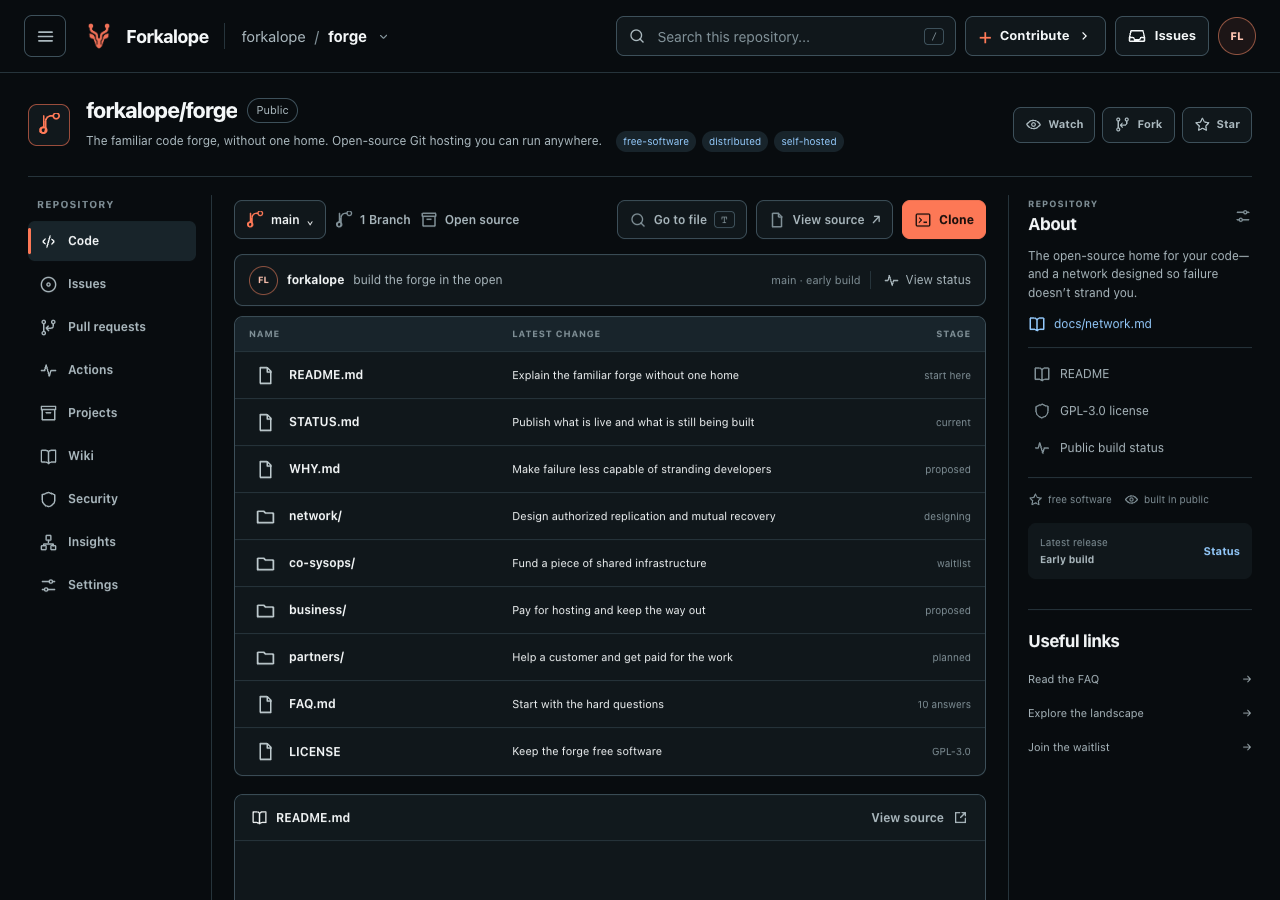
Those rows were links to sections of a website, rather than a live repository browser. That distinction matters because a convincing interface can get ahead of the software behind it. The stage labels helped, but the page still asked a visitor to take in a forge, a distributed network, hosting, memberships, and partner work before choosing a place to start. That’s a lot of future to put on one screen.
The forge gets a different job
On September 14, 016cb3d, “reframe homepage as flight school,” replaced that repository presentation with a school document. The important change fits in two sentences from the new copy:
The school is the first product. The open-source forge is the training aircraft: a real system students can inspect, change, break safely, recover, and eventually help operate.
The proposed forge still had work to do, but the school gave it a particular use. Git hosting makes a plausible training subject because the exercise can involve something a developer already cares about. If pushes fail while reads succeed, you have a specific symptom to investigate and a service to restore. “Learn operations” becomes easier to evaluate when there’s an operation in front of you.
The next positioning commit, 7e5d770, named SRE and DevOps explicitly. It also changed the assessment heading to “The checkride measures SRE judgment.” A checkride is the proposed final observed exercise. The rubric covers safety, diagnosis, execution, communication, and follow-through, so getting the service working is only part of the intended assessment.
Put a decision in front of the visitor
A school description can make the same mistake as a hosting description: enough plausible promises and still nothing to try. f92ba88, “make SRE school homepage actionable,” added the failed-push drill, a first-cohort interest form, and a named founder section.
The drill is the most useful addition for understanding the proposed teaching. Its incident brief says developers are getting 502 errors on pushes, reads are healthy, and the last deploy was eighteen minutes ago. It offers two first moves:
- Restart immediately
- Restart push-api.
- Investigate first
- Confirm the edge-to-origin path and blast radius.
A recent deploy is a lead. It isn’t a diagnosis. The log includes an origin connection refusal, which gives the student something narrower to investigate before reaching for a restart. The feedback favors establishing scope and preserving evidence. It’s a small interaction, but it lets a visitor disagree with a teaching decision instead of merely nodding at a curriculum list.
The student’s proposed submission also goes beyond a working service. It includes an investigation, the smallest reversible recovery change, and a record covering the timeline, customer update, verification, and prevention recommendation. Those are things another operator could review later.
The demo has a limit you can see in the code
The September 16 commit cfbff72, “much more exciting,” expanded the visual presentation into fleet and incident displays. The incident view draws the request path, shows charts, and places a server beside the failed push service. The first-decision exercise remains below it. This is the current exercise, captured from the page:
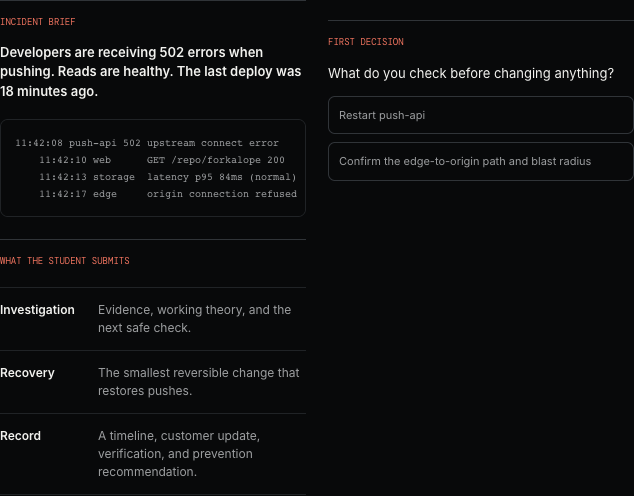
The JavaScript at that commit makes the demo’s scope clear. Clicking an answer selects a button and writes one of two feedback messages. It doesn’t start a lab or restart a service. The fleet’s regional counts and machine rosters are defined in the script; the changing capacity percentage adds a small sine-wave variation to a preset value. These are simulated displays, not measurements from an operating fleet.
That’s fine for showing the proposed exercise. It would be a lousy substitute for one. An eventual lab needs to let students gather evidence, make changes, and verify the outcome. Picking the preferred answer on a homepage demonstrates the teaching direction; it doesn’t demonstrate a student’s ability to recover a system.
Keep the offer as specific as the drill
The actionable-homepage commit also made the next step an expression of interest. Its form prepares an email draft with the visitor’s experience and learning goals. It doesn’t create an enrolled student or collect tuition. That’s an appropriate-sized action while the schedule, format, and price are still being developed.
Then bb1c4d5, “legal,” revised the privacy and terms pages on September 18. They identify themselves as drafts and describe the site as an early preview. The terms distinguish simulated training from production access, and leave enrollment and paid operational work subject to future terms and separate authorization. A polished server display doesn’t make any of those commitments disappear.
The strongest change across these commits is the narrower question the homepage can now answer. Someone considering SRE training can inspect a failed push, choose a first check, and see what work a reviewer would expect afterward. The next proof has to come from a lab where the investigation and recovery actually happen. Until then, the demo gives visitors a concrete proposal to judge, and the commit history lets them see exactly how far it goes.